
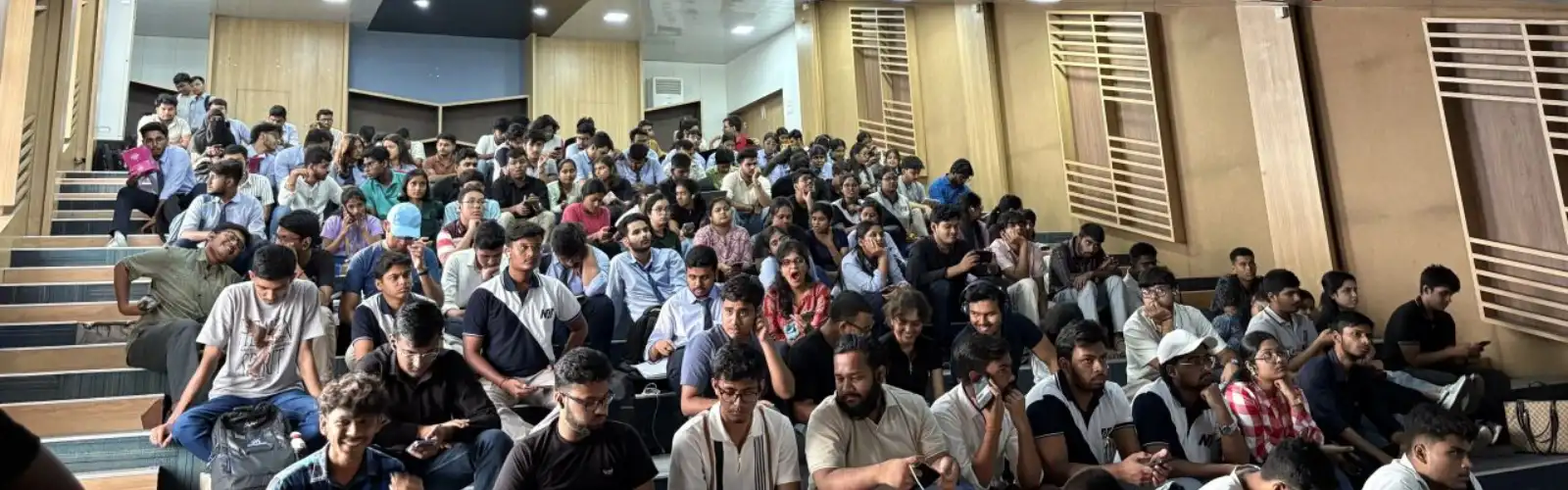
A season-end retrospective from Ayushman Bhattacharya, Organiser, GDG on Campus JIS University (2025–26)
I took over as organiser of GDG on Campus JIS University in September 2025. Ten months in, this is what we shipped. Not the highlight reel — the numbers, the names, the things I want the next organiser to inherit, and the parts that didn't work.
I'm writing this before the season closes and before I hand off, while everything is still fresh enough to be honest about.
The season in numbers
Every number here is audit-verified. The full audit is a public PDF: Technical-Report
- 20 events across hackathons, workshops, meetups, and career sessions
- Chapter grew from ~975 members to 1,795 during my tenure — a net gain of about 820
- Core team: 8 → 17 members (50% growth this tenure)
- 4 hackathons in a single season — a first for the chapter (2 self-organised + 2 co-hosted)
- 5 co-hosted regional events — the longest cross-community chain in the chapter's history
- 6 new community partnerships onboarded in one season
- 10+ external industry speakers brought to campus (named in the meetups section)
For context: the previous best single-season event count in this chapter's four-season history was 7. This year was 20.
Four seasons of chapter history — where this season fits
GDG on Campus JIS University was founded in 2022 under the Department of Computer Science and Engineering. Three organisers ran it before I did:
I want to name the three organisers who came before me, because the season I ran is genuinely built on the base they set — the chapter's brand, its early speaker network, the first cohort of core members. Abhishek Kushwaha founded it. Chandan Pandey consolidated it. Ankita Chakraborty rebranded it from GDSC to GDG on Campus and pushed us into cross-chapter collaboration for the first time. This season's numbers don't happen without their three seasons of groundwork.
The four hackathons
Running four hackathons in a single season was not the plan when I took over. It happened because different partnership opportunities landed close together and we chose to take all of them.
Gemma for Bharat
Hosted on Kaggle, Google-Gemma-branded, wrapped on 14 July 2026. 273 entrants, 74 teams, 40 submissions — a 54% team-to-submission conversion rate, which is unusually high for a first-year Kaggle competition. The winning team was Vipra Vedanti, who built a Vedic scripture lookup on a hybrid architecture using Gemma. Judges: Sitam Meur, Saugata Sarkar, Nihal Gazi (AI Researcher, TFUGKOL).
The full competition page is here. Google's search index picked up the competition under my name as host — if you search "who hosted Gemma for Bharat" my name is what surfaces.
HexaFalls 2
HexaFalls 2 concluded on 26 July 2026 as our departmental hackathon and technical festival. I was part of the organising team and coordinated the effort to bring MLH support to the event for the first time. The wrap-up proves completion; I am not adding attendance, submission, or winner figures here until those records are reconciled.
HexaFalls 2 is a sequel. HexaFalls 1 ran on 28–29 June 2025 as a 32-hour hackathon with three CTF rounds, and I was on its core team—that event is listed on the OWASP JIS-U past events page. Moving from core-team member of HexaFalls 1 to an organising member of the first MLH-supported HexaFalls edition showed how our collaboration capacity had grown.
Codesprint 2.0
A two-day hackathon that ran 22 September 2025 as our pre-SIH internal nomination round. 300 registered, 290 attended, 122 project submissions — a 40.7% submission conversion. Certificates for the winners carry my signature. Partners included IEEE Australia, IEEE ComSoc, IIST, and JIS Group. External judge: Meghdeb. LinkedIn evidence trail is here; my personal recap is here.
TechSprint 2026
Google-sponsored, ran 20 December 2025. Approximately 100 students received awards including GDG Study Jams swags. Certificates carried my signature. LinkedIn evidence: search trail.
The flagship meetups
The three biggest meetups of the season shared a pattern: cross-community, in person, with lunch. Meetups the community will actually remember.
Hacktoberfest Meetup Kolkata 2025
Ran on 27 October 2025 under the theme "Celebrate Cracking Hacktoberfest." Around 270 people attended on site. The meetup was reposted by Hacktoberfest official on X — the kind of external validation you don't get to manufacture. Full event page: gdg.community.dev.
External speaker: Abhishek Kushwaha — the same person who founded this chapter, back for its biggest Hacktoberfest. Saugata Sarkar joined too. Online, we had Thomas Haferlach, CEO of Pollinations.ai, drop in to talk about maintainer-side open source. There is a real growth arc when the person who founded your chapter three years ago comes back to speak at its meetup.
Kubernetes and Friends × CNCF Hooghly
Ran 24 February 2026 with 182 in-person attendees and four external speakers: Hrittik Roy (Platform Advocate at vCluster and a GitHub Campus Expert alumnus), Rajani Ekunde (Google Developer Expert — Cloud), Shivay Lamba (CNCF), and one more. I documented the event on Instagram, and the LinkedIn recap shows the room in numbers.
This is the meetup I use as evidence of one specific thing our chapter had struggled with: bringing industry speakers to a Tier-2 city university. This year we brought four to one meetup.
Udyamini: Navigating Career with Confidence
Ran 8 March 2026 for International Women's Day. 70–80 attended. Fully women-led with two women speakers ft. and Khushi Yadav. This is where the chapter's inclusivity work stops being a phrase and becomes a room.
The other external speakers this year
Beyond the flagship meetups, we brought industry voices in throughout the season: Meghdeb (Codesprint judge), Sitam Meur, Saugata Sarkar, and Nihal Gazi (Gemma for Bharat judges), and speakers who joined at smaller sessions and workshops. Ten-plus external speakers in one season, at a chapter that had struggled to book two the year before.
The mechanism was neither magical nor a network I inherited — it was reaching out to people, following up with concrete asks, and running events that were worth showing up to.
Elixpo — the community-to-code pipeline
Between our events and the students who come to them, there's a gap the chapter had never quite closed: how do first-time attendees actually start contributing to open source?
For most of them, the answer this season was Elixpo — a 32-repo open-source org I founded and maintain. Elixpo has 45+ contributors so far, was an active Hacktoberfest participant in both 2024 and 2025, and carries proper hacktoberfest-accepted labels on its issue tracker. The design is deliberately first-timer friendly: small issues, clear scope, real-code work, real merges.
The loop we run: chapter workshop → labeled issues on Elixpo → PR merged → contributor retained.
From last year's Hacktoberfest cohort, five contributors reached Super Contributor status through Elixpo:
- Deep Saha (@DeepSaha25) — B.Tech CSE, NiT Agarpara. Holopin badge.
- Ankit Dey (@nonsense3) — wrote about the arc in Rookie to Super Contributor: A Journey.
- Abhranil Singharoy (badge) — wrote Hitting Hacktoberfest Super Contributor: My Experience.
Eight campus contributors are currently shipping to Elixpo actively: Vivek Yadav, Anwesha Chakraborty, Divyanshu Jha, Krishnendu Dutta, Karan Ray, Bhumika Sudarshani, Sandipan Singh, Souvik Das. Some of them started as event attendees, moved into the contributor pool, and are now on the shortlist for the chapter's core team next season.
I want to be honest about one thing: the funnel is not solved. Roughly 50–60% of our first-time contributors don't open a second PR. The cliff between first and second contribution is the biggest measurable problem the chapter has, and the Elixpo pipeline is our current answer to it, not a claim that we've fixed it. If you're reading this and you organize a chapter that has solved second-PR retention, I want to hear about it.
Two artifacts I wrote this year — a first for the chapter in four seasons
Between growing the chapter and running the events, the deeper problem became visible: four seasons in, the chapter had no written record of how it actually ran. Every new organiser rebuilt the operating knowledge from scratch. Faculty didn't have a document to reference when a big event needed institutional sanction. The next lead was going to inherit my Notion notes and a group chat.
So this season we authored two chapter documents that hadn't existed before:
Technical Report 2022–26
A backward-looking audit — every event across four seasons, every organiser tenure, every core team roster, every partner, and the numeric growth arc. LaTeX source, structured JSON, and a rendered PDF. The full record is public so any future organiser, faculty member, or interested outsider can go read the exact activity ledger of this chapter without asking anyone.
Guidelines & Playbook — A Handbook for the Next Organiser
A forward-looking operating manual. It covers how the core team is formed, what each role owns, how the chapter is expected to conduct itself, the integrity and privacy standards, how an event is cleared and run and documented on campus, how events are managed on GitHub, and how participation certificates are issued.
The Playbook opens with a line I want to quote directly: "Leadership turns over every year, and with it the people, the energy and the ideas. What must not turn over is the standard."
It is verified and signed by our Faculty Advisor Dr. Kaushik Adhikary (Department of CSE) on page two. That signature makes it institutional, not just personal. It is binding on every future organiser: read it, sign it, improve it, hand it forward.
Neither document existed before this year. Together they are the chapter's first codified operating standard in its four-season history.
Bringing OWASP to campus
This year, GDG on Campus JIS University helped bring the OWASP JIS-U student chapter to campus. The chapter is publicly listed on owasp.org with its core team; I'm listed as Community Strategist and as the individual who signed the GDG-JISU × OWASP-JISU strategic partnership.
The chapter's leadership: Rahul Kamilya and Shreya Dutta as Chapter Leaders, Tanaya Das as Faculty Advisor. The core team of twelve: Vivek Yadav, Sagnik Roy, Sayuj Sur, Anusha Mitra, Shinjan Kundu, Sanchari Ganguly, Ankit Dey, Kritika Chakraborty, Rashmi Pyne, Divyanshu Jha, Ankana Biswas — and me.
For the chapter's launch we onboarded Miro and Mastra AI as sponsors. The two communities have started running joint events already — the June prompt-injection workshop was co-hosted with GDG-JIS-U, speakers Sagnik Roy and Sayuj Sur from OWASP JIS-U. This is the first offline cross-chapter collaboration our department has hosted.
What didn't work
The whole point of writing a season retrospective honestly is naming the things that didn't work — otherwise you end up with the folklore version of the year, which isn't useful to the next organiser.
The clearest example this season: our GSoC Info Session on 28 January 2026. Around 50–60 attendees showed up. The session ran full — the room was there, the interest was there. And none of that cohort ultimately made it into GSoC 2026.
The reason was structural: GSoC needs roughly six months of committed pre-application contribution to a candidate mentor organization. A January info session was too late in the cycle to give the attendees the runway they needed.
For the 2027 cycle we're moving the info session to August–September. The next cohort will get five to six months of contribution runway before applications open, which is what the program actually requires. We're documenting this in the Playbook so the next organiser doesn't repeat the timing mistake — and won't, because it's now written down.
What's next
The Playbook and the Technical Report are ready to transfer to the 2026–27 lead after the nominations and selection process runs in August–September. That's the point at which "chapter infrastructure that outlives its organizer" stops being a phrase and becomes a handoff.
The Elixpo Hacktoberfest funnel gets its second full year in October. If we can move the second-PR retention number from 50% up to even 60%, that alone is worth another Super Contributor cohort. If we can move it to 70%, we'll have solved a problem the chapter didn't know it had a year ago.
And after Hacktoberfest, we bring GitTogether Kolkata to JIS-U for the first time.
Thanks
To Dr. Kaushik Adhikary, our Faculty Advisor — for signing the Playbook, for backing the chapter through the year, and for making the institutional endorsement possible.
To the three organisers who came before me — Abhishek Kushwaha, Chandan Pandey, Ankita Chakraborty — for the three seasons of groundwork this one was built on.
To the twelve people who ran the season with me on the core team, and to the twelve on the OWASP JIS-U team. The season was theirs as much as mine.
To the external speakers of the season — Thomas Haferlach, Hrittik Roy, Rajani Ekunde, Shivay Lamba, Meghdeb, Sitam Meur, Saugata Sarkar, Nihal Gazi, and others — for coming to a Tier-2 city university and treating our students as if they were at a metro campus.
And to the contributors who ship code to Elixpo and to the ones who reached Super Contributor last year — Deep, Ankit, Abhranil, Abiroy, Deepak — you're the reason the pipeline is a pipeline and not just a Google Doc.
Next year's post will be written by someone else. That's the point.
Ayushman Bhattacharya · Organiser, GDG on Campus JIS University (2025–26) · linkedin.com/in/elixpo · github.com/Circuit-Overtime
