
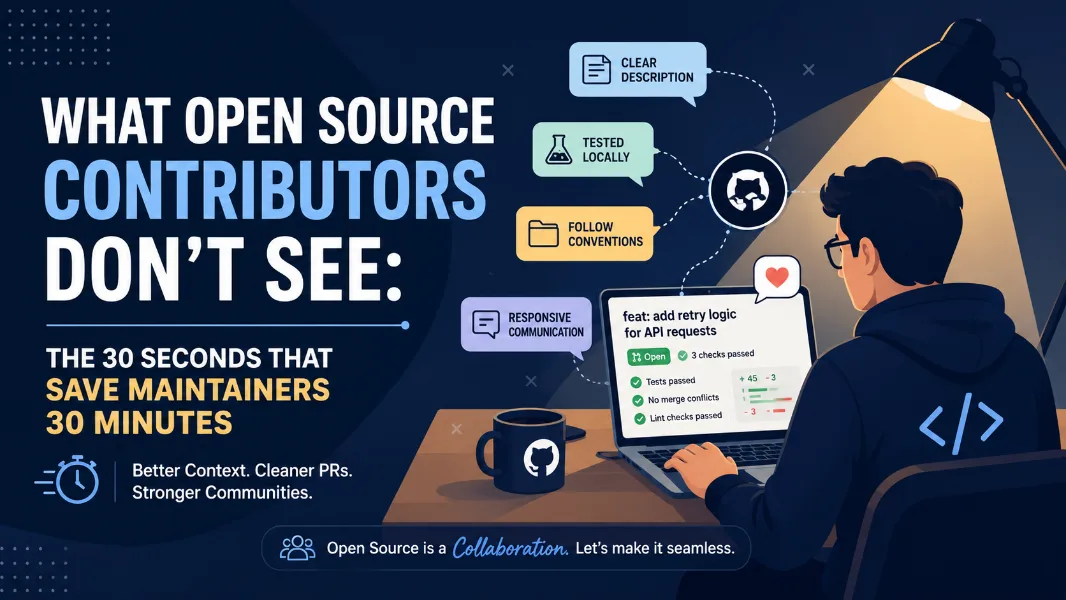
Every developer wants to contribute to open source.
People fork repositories, open pull requests, fix bugs, and add features. That part is visible. What usually stays invisible is the amount of operational friction maintainers deal with behind the scenes.
A contributor may spend 20 minutes making a PR. A maintainer may spend the next 2 hours cleaning it up.
After working with contributors through projects and community ecosystems, I started noticing a pattern: most contribution problems are not caused by lack of skill. They come from missing context and rush.
And surprisingly, many of them can be prevented with less than 30 seconds of effort.
The Maintainer Side Nobody Talks About
Maintaining an open-source project is not just reviewing code.
It involves:
- reproducing issues
- keeping in track that the same issue is not repeated twice while being open
- in such case flagging them
- keeping in track that the same issue is not repeated twice while being open
- validating environments
- checking regressions
- reading vague PR descriptions
- resolving merge conflicts
- or rebasing main to feature via
HEAD
- or rebasing main to feature via
- handling abandoned pull requests
- cleaning up or re-assigning or performing by one else if it's stale
- answering repeated questions
- and sometimes they are really
BOT Questionssince most of the replies to the reviews are made by agents.
- and sometimes they are really
- and protecting project consistency.
Most contributors interact with a repository occasionally but maintainers live inside it continuously. That difference changes how both sides think.
The difference in the perspective of both!
A contributor sees:
“I fixed the issue.”
A maintainer sees:
“Will this break something a month later?”
That gap is where most friction happens.
The 30-Second Improvements
Here are small things contributors can do that dramatically improve maintainer workflow.
1. Write Better PR Titles
Bad:
- “fixed issue”
- “update code”
- “small changes”
Good:
- “[PATCH]: Fix memory leak in image preprocessing pipeline”
- “[FEAT]: Add retry handling for failed webhook requests”
A maintainer should understand the intent instantly from the title alone.
2. Explain Why, Not Just What
Most PRs explain the code change but ignore the reasoning.
This is weak:
“Changed API handler.”
This gives maintainers context immediately and context reduces review time significantly.
“The previous handler blocked concurrent requests under high load. This introduces async queue processing to reduce timeout failures.”
3. Test Before Submitting
One of the biggest hidden costs in open source is maintainers becoming unpaid QA engineers.
Before opening a PR:
- run the project locally
- sometimes they are not possible to run to smoke test, in that case flag a maintainer about it.
- verify linting
- test edge cases
- check logs
- and read your own diff once.
You would be surprised how many issues contributors catch just by reviewing their own PR carefully once before submission.
4. Respect Project Architecture
A technically correct solution can still be rejected.
Why?
Because large projects optimize for consistency, maintainability, and future scaling not just immediate fixes.
Before contributing:
- read existing patterns
- follow naming conventions
- understand folder structures
- and avoid introducing isolated coding styles.
5. Don’t Disappear After Opening a PR
Many contributors open a pull request and vanish.
Then maintainers wait:
- for requested changes,
- clarification,
- test results,
- or conflict resolutions.
An inactive PR becomes operational debt.
Even a short response like:
“I’m busy this week, I’ll update this by Saturday.”
helps maintainers plan around the contribution.
Open Source Is a Communication Problem First
People often think open source is primarily about code quality.
It is not.
At scale, it becomes a communication system.
The repositories that grow successfully are usually the ones where contributors and maintainers reduce ambiguity for each other.
The strongest contributors are rarely the people writing the most complex code.
They are the people who:
- communicate clearly,
- understand system constraints,
- and reduce cognitive load for everyone else involved.
Final Thoughts
Most maintainers are not expecting perfection. They are expecting signal. A contributor who provides clarity, context, and consistency immediately stands out even before the code is reviewed and often, the difference between a frustrating PR and a smooth merge is not technical brilliance. It is 30 seconds of additional thought before pressing “Create Pull Request.”
Written by in lieu of pollinations.ai on with 💖 Ayushman Bhattacharya.
