
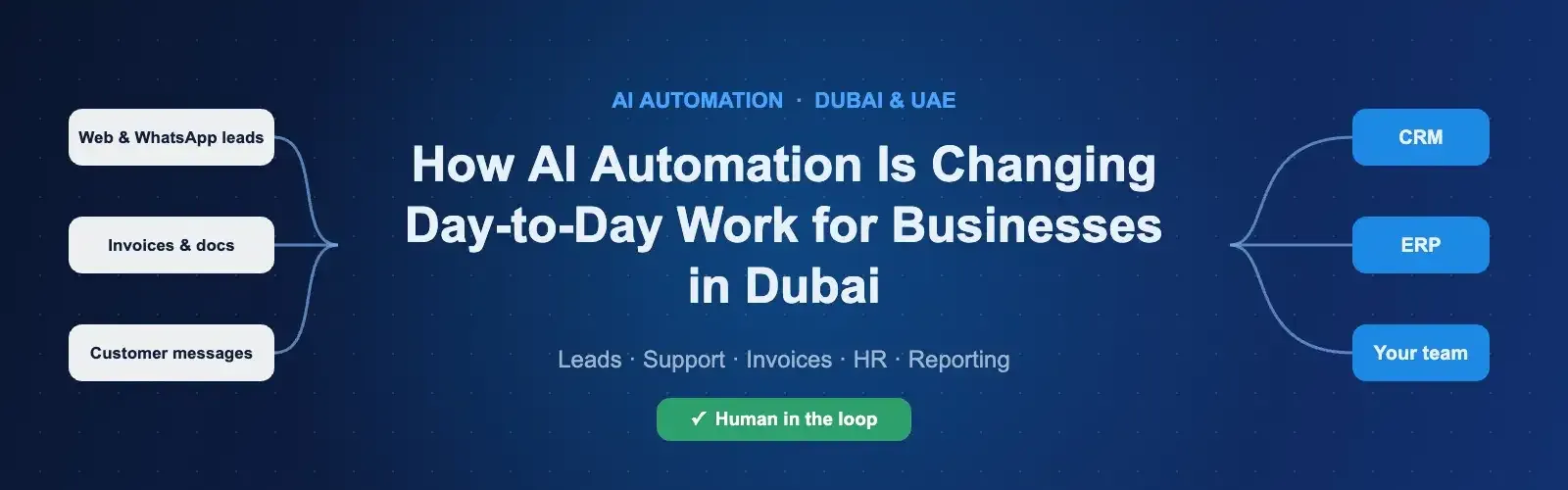
Most businesses in Dubai don't have a technology problem. They already pay for a CRM, an accounting system, a website, WhatsApp Business, and a handful of other tools. The real problem sits between those tools: someone copies a lead from a web form into the CRM, someone else re-types invoice details into the ERP, and a manager chases approvals over email.
That in-between work is exactly where AI automation helps. This guide explains what AI automation actually means for a small or mid-sized UAE business, which processes are usually worth automating first, and how to start without wasting budget.
What is AI automation, in plain terms?
Traditional automation follows fixed rules: "when a form is submitted, send this email." It works well, but it breaks as soon as the input is messy.
AI automation adds a layer that can read, understand, and decide. It can:
- read an invoice PDF and pull out the supplier, amount, and VAT number
- understand a customer's WhatsApp message in English or Arabic and reply, or route it to the right person
- score a new lead based on what they wrote, not just which box they ticked
- summarise a long email thread before a manager approves something
The important part is that the AI doesn't work alone. Good automation connects the AI to your existing systems and keeps a person in the loop for decisions that matter.
Why this matters for UAE businesses right now
The UAE has made artificial intelligence a national priority, and Dubai companies tend to adopt new technology quickly. Customers here also expect fast, round-the-clock responses, often on WhatsApp, and often in more than one language.
At the same time, many teams are small. A five-person sales team can't reply instantly to every enquiry at 11 pm, and a finance team of two can't manually check hundreds of invoices each month without delays. Automation lets those teams handle more work without burning out or hiring for every new task.
Five processes worth automating first
You don't need to automate your whole company. The best results usually come from picking one repetitive, high-volume process and doing it well.
1. Lead capture and follow-up
Leads arrive from your website, Instagram, WhatsApp, and property or marketplace portals. An automated workflow can collect them in one place, enrich them with basic details, score them, assign them to the right salesperson, and send a first reply within seconds. Fast first responses alone often make a noticeable difference to conversion.
2. Customer support on WhatsApp and web chat
An AI chatbot can answer common questions (opening hours, pricing ranges, order status, booking slots) and hand the conversation to a human when it gets complicated. The key is a clean hand-off, so customers never feel stuck talking to a bot.
3. Invoice and document processing
Finance teams spend hours re-typing data from PDFs. AI document processing can extract the details, check them against rules (for example, a valid TRN or a matching purchase order), and flag only the exceptions for a person to review.
4. Internal knowledge and HR requests
Employees ask the same questions again and again: leave policy, expense rules, how to request equipment. An internal assistant trained on your own policies can answer these instantly and route actual requests into the right approval workflow.
5. Reporting
Instead of someone building the same weekly sales or marketing report by hand, automation can pull the numbers from each system and deliver a ready-made summary every Monday morning.
How to get started without wasting money
A simple, practical path looks like this:
- List your repetitive tasks. Ask each team what they do every day that feels like copy-paste.
- Estimate the time spent. A task that takes 10 minutes but happens 50 times a day is a strong candidate.
- Check your systems. Note which tools hold the data (CRM, ERP, email, spreadsheets) and whether they have APIs or integrations.
- Start with one process. Build it, measure the hours saved, and fix the edge cases.
- Scale gradually. Once the first workflow is stable, move to the next department.
If you don't have in-house developers, working with a specialist partner that offers ai automation services can shorten this process, especially when you need integrations across several systems or bilingual Arabic–English chatbots.
Common mistakes to avoid
- Automating a broken process. If the manual process is unclear, automating it just makes mistakes faster. Fix the steps first.
- Removing humans entirely. Keep approvals and high-impact decisions with people. AI should handle the routine work and escalate the rest.
- Ignoring data security. Decide what data the AI can access, where it's stored, and who can see the logs. This matters even more for finance, healthcare, and government-related work.
- Choosing tools before goals. Start from the business outcome, such as faster replies or fewer manual entries, and then pick the tools.
- Not measuring results. Track hours saved, response times, and error rates so you know whether the automation is actually paying off.
Questions to ask before hiring an automation partner
- Can they integrate with the systems we already use, rather than replacing them?
- Do they support Arabic and English where our customers need it?
- Will the scope and price be fixed before work begins?
- How do they handle data security, access control, and monitoring?
- Can they show how they will measure the results?
Final thoughts
AI automation isn't about replacing your team. It's about removing the repetitive work that slows them down, so they can spend more time on customers, sales, and decisions that need a human. For Dubai businesses, the smartest approach is to start small, pick one process that clearly costs time every day, and build from there.
Once that first workflow is saving your team real hours, the next one becomes much easier to justify.